El mirador de LucreciaThe Lucretia Lookout
Del boceto al cuadro terminado: cinco semanas de pintura, materia y decisiones.From sketch to finished painting: five weeks of paint, matter and decisions.
Suave, mari magno turbantibus aequora ventis,
e terra magnum alterius spectare laborem…
«Es dulce, cuando en el ancho mar los vientos revuelven las aguas, contemplar desde tierra el gran esfuerzo de otro…»
“Sweet it is, when on the great sea the winds are churning the waters, to watch from land another’s great struggle…”
LucrecioLucretius, De rerum natura, II, 1–2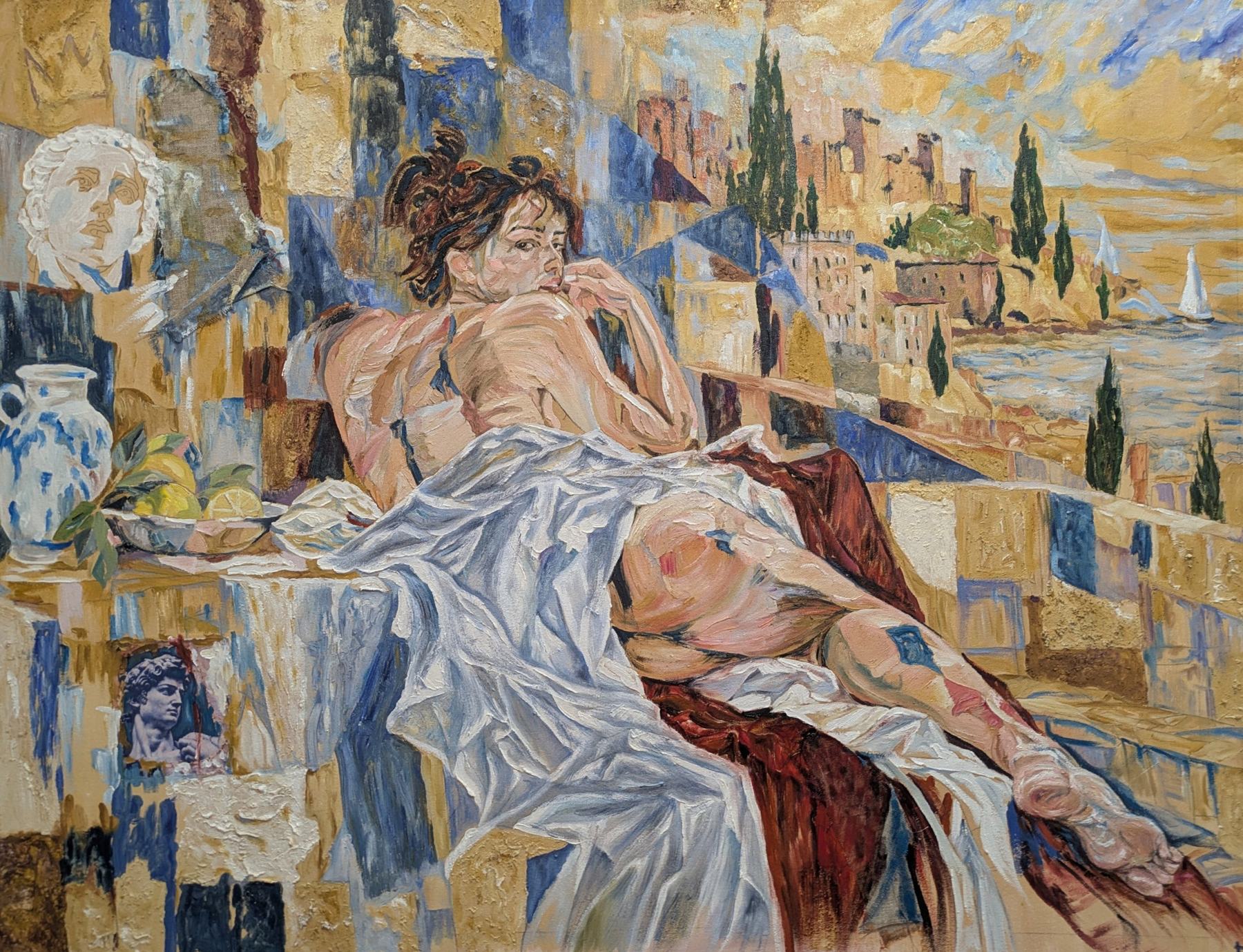
Cómo se hizoHow it was made
El cuadro se pintó entre finales de septiembre y principios de noviembre de 2026. Las fotos del taller muestran el orden de trabajo: primero el dibujo sobre una base ocre, después la figura, la red de teselas que la rodea, el paisaje y, al final, los objetos, el collage y el pie.
The painting was made between late September and early November 2026. The studio photographs show the working order: first the drawing on an ochre ground, then the figure, the grid of tesserae around it, the landscape and, at the end, the objects, the collage and the foot.
-
Dibujo sobre base ocreDrawing on an ochre ground
El lienzo de 120 × 90 recibe una imprimación cálida y una cuadrícula. Encima se dibuja a lápiz toda la composición: figura, telas, arquitectura y teselas.
The 120 × 90 canvas gets a warm priming and a grid. The whole composition is drawn on top in pencil: figure, fabrics, architecture and tesserae.
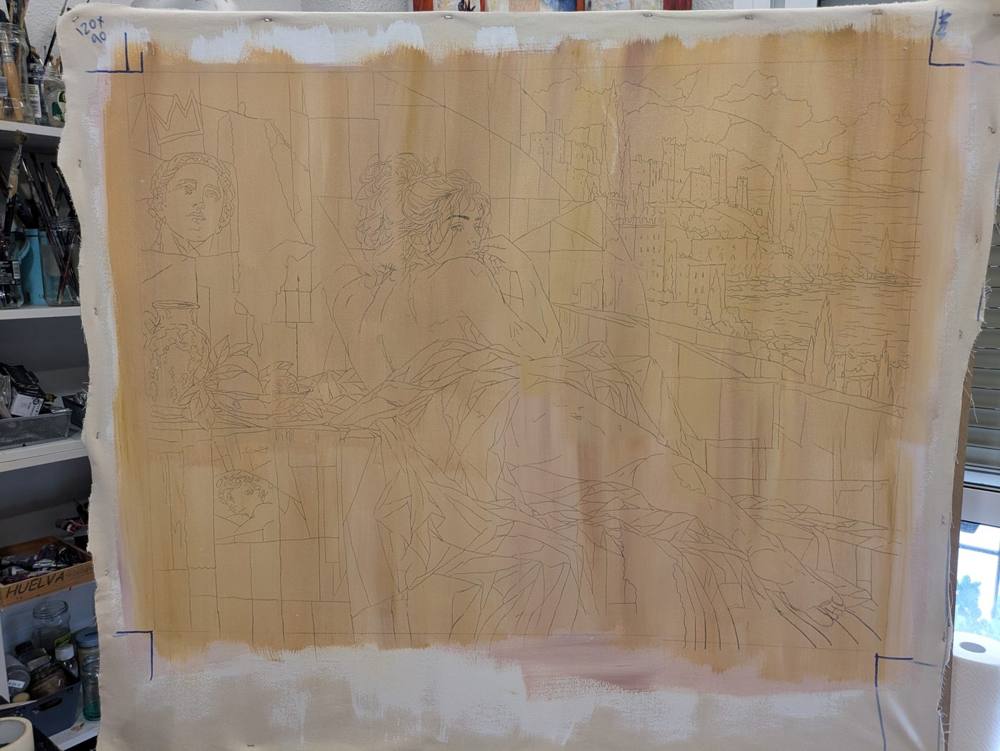
28-09-2026 -
Primeras carnacionesFirst flesh tones
La pintura empieza por los dos extremos de la figura, la espalda y la pierna, y por los primeros bloques azules. Así quedan fijados enseguida la luz y la temperatura del cuadro.
Painting begins at the two ends of the figure, the back and the leg, together with the first blue blocks. This sets the light and temperature of the picture from the start.
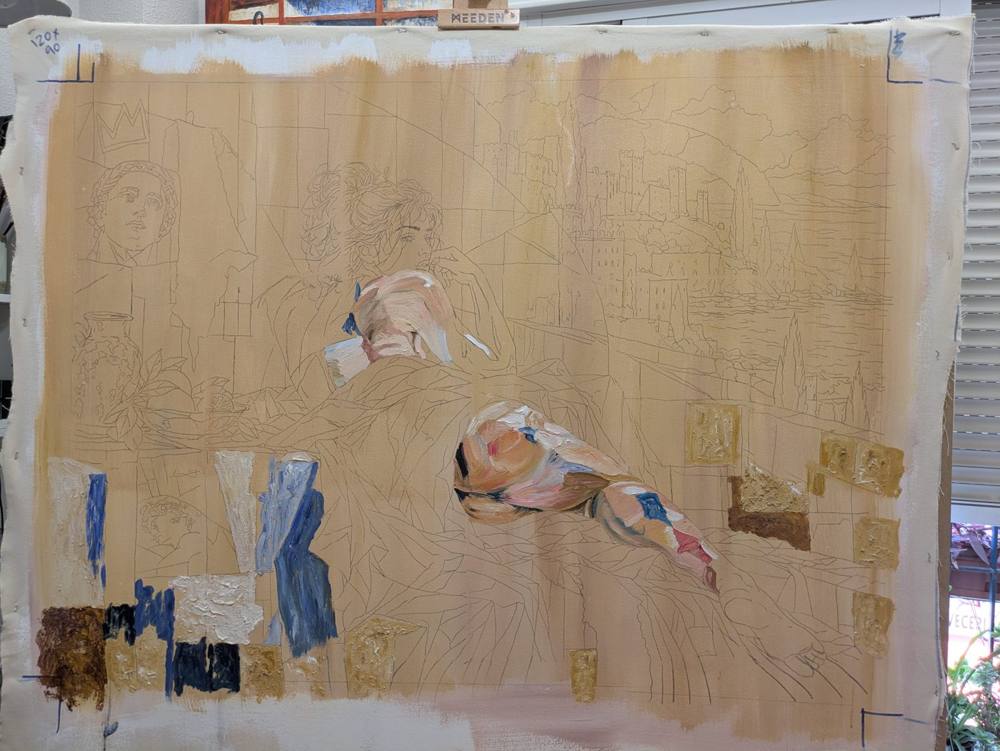
30-09-2026 -
La figura completaThe whole figure
Aparecen la cabeza, el pelo recogido y el drapeado blanco que atraviesa el cuerpo. Abajo a la izquierda se ensayan los primeros parches de materia y ocre oscuro.
The head, the gathered hair and the white drapery crossing the body appear. Lower left, the first patches of texture and dark ochre are tried out.
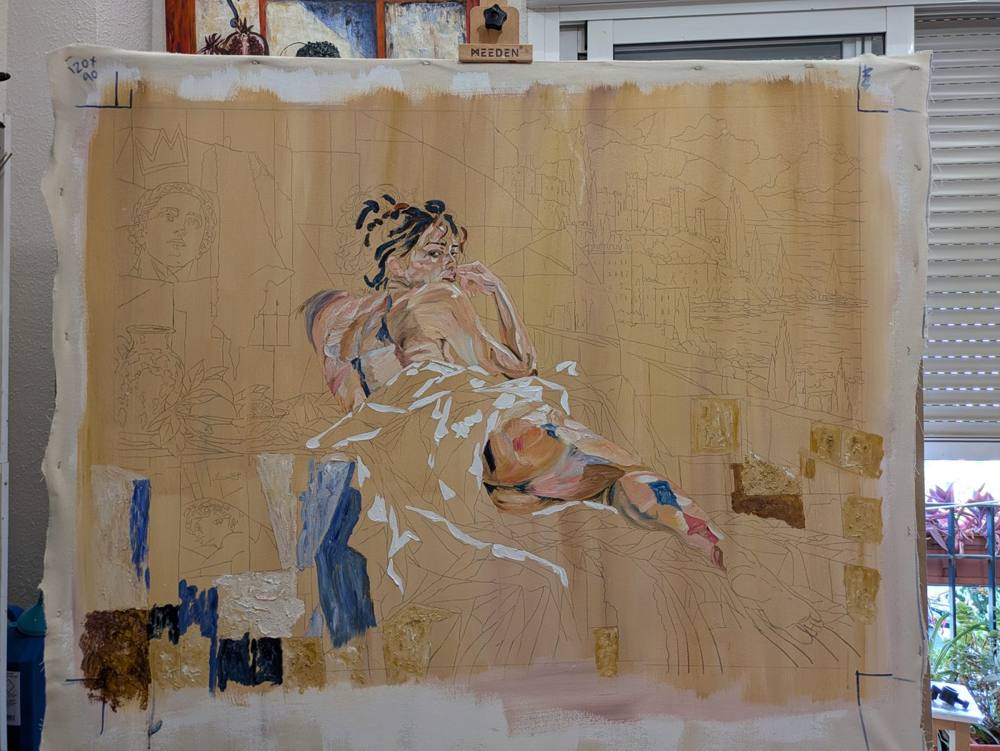
02-10-2026 -
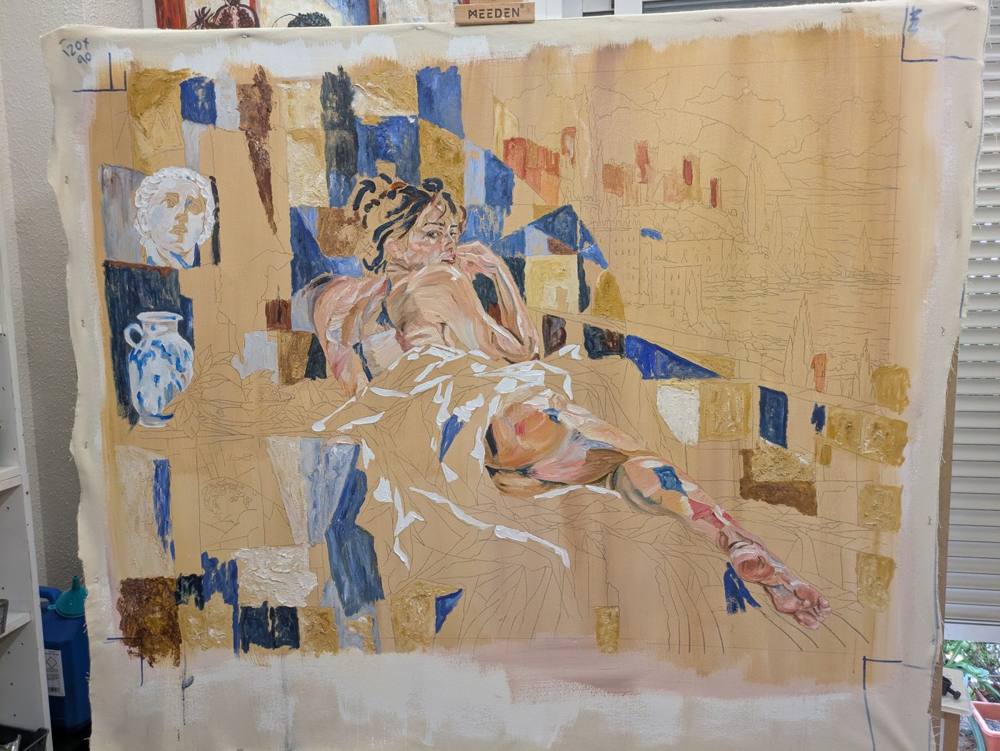
La red de teselasThe grid of tesserae
Los triángulos y rectángulos azules se extienden por la mitad izquierda. Entran el busto clásico y el jarrón azul y blanco, y el fondo empieza a funcionar como un mosaico.
Blue triangles and rectangles spread across the left half. The classical bust and the blue-and-white jug come in, and the background starts to work like a mosaic.
04-10-2026 -
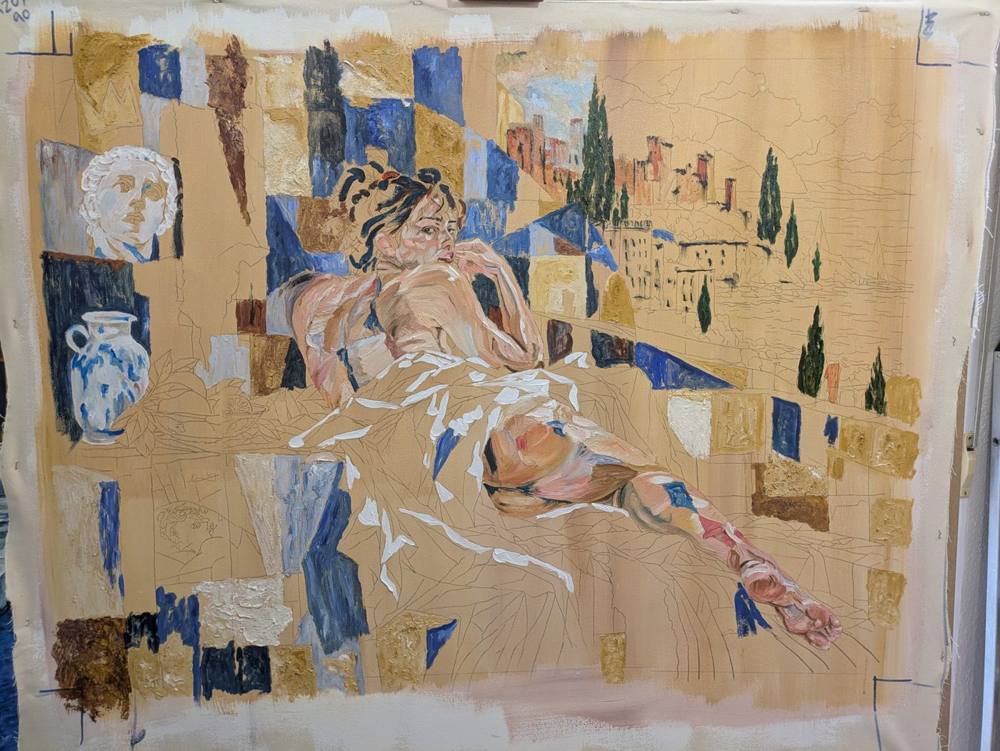
Se abre el paisajeThe landscape opens
A la derecha surgen la ciudad amurallada, los cipreses y la primera línea de mar. El cuadro se reparte entre dos mundos: el interior geométrico y el exterior abierto.
On the right the walled town, the cypresses and the first line of sea emerge. The picture divides into two worlds: the geometric interior and the open exterior.
05-10-2026 -
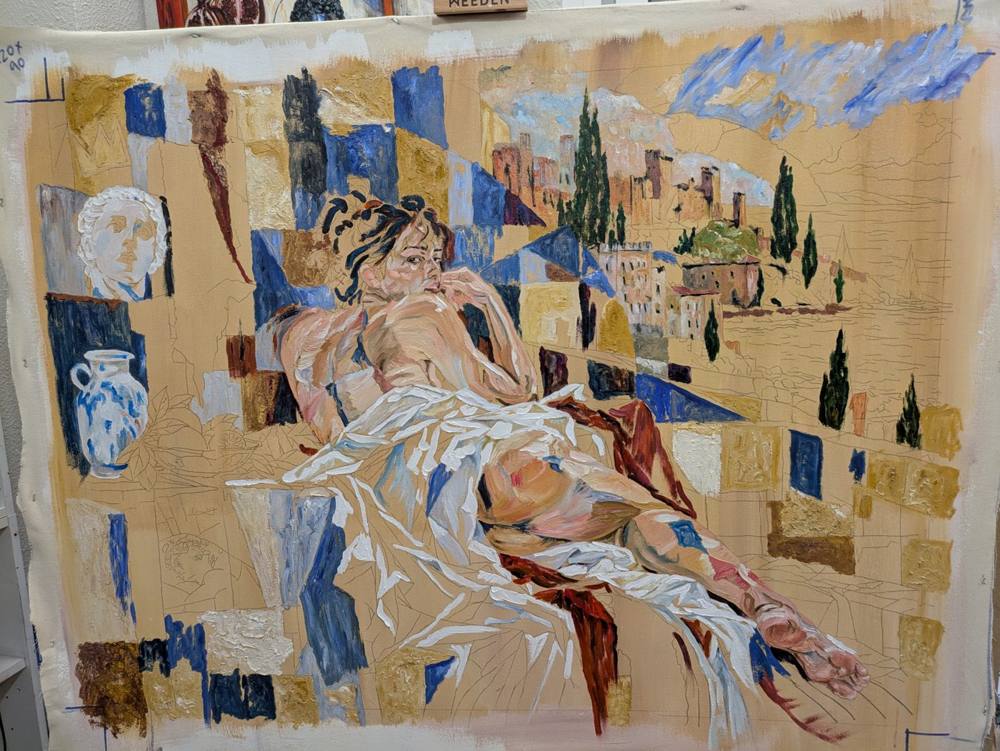
Cielo, mar y velasSky, sea and sails
El cielo se resuelve con pinceladas amplias de azul y dorado, y aparecen las velas en el horizonte. Las telas se enriquecen con los primeros rojos.
The sky is resolved in broad strokes of blue and gold, and the sails appear on the horizon. The fabrics are enriched with the first reds.
07-10-2026 -
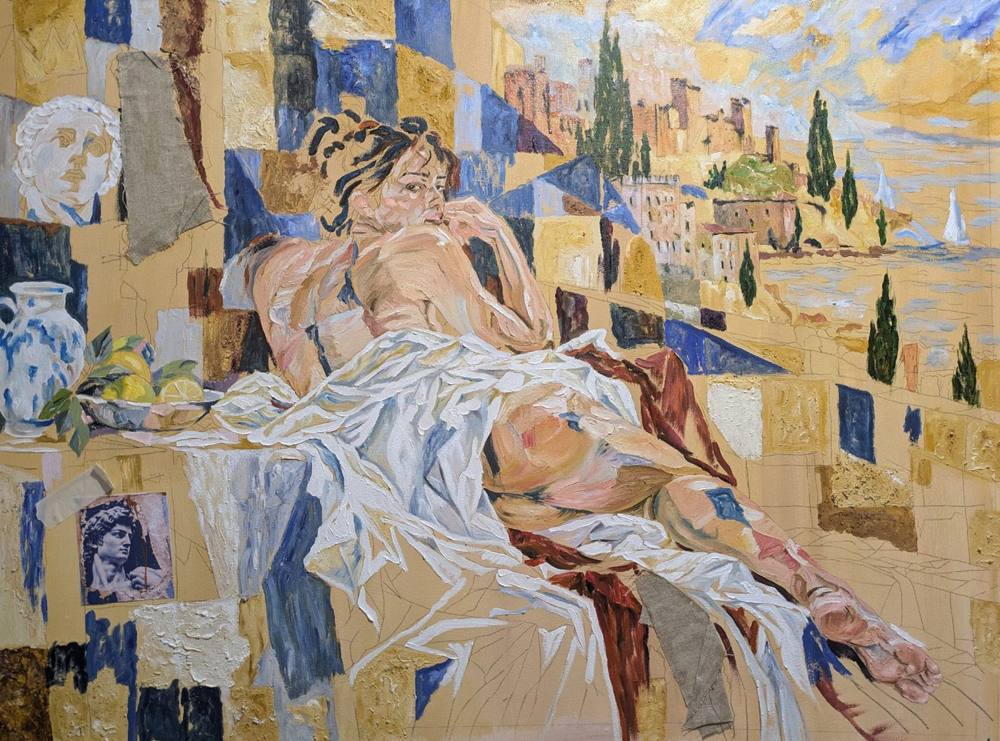
Limones y el DavidLemons and David
Se pinta el bodegón de limones y se pega abajo a la izquierda un recorte fotográfico del David de Miguel Ángel. Es un collage deliberado, una nota de ironía: la escultura más célebre entra como papel impreso, no como pintura.
The still life of lemons is painted, and a photographic cut-out of Michelangelo’s David is glued at lower left. It is a deliberate collage, a note of irony: the most famous sculpture enters as printed paper, not as paint.
13-10-2026 -
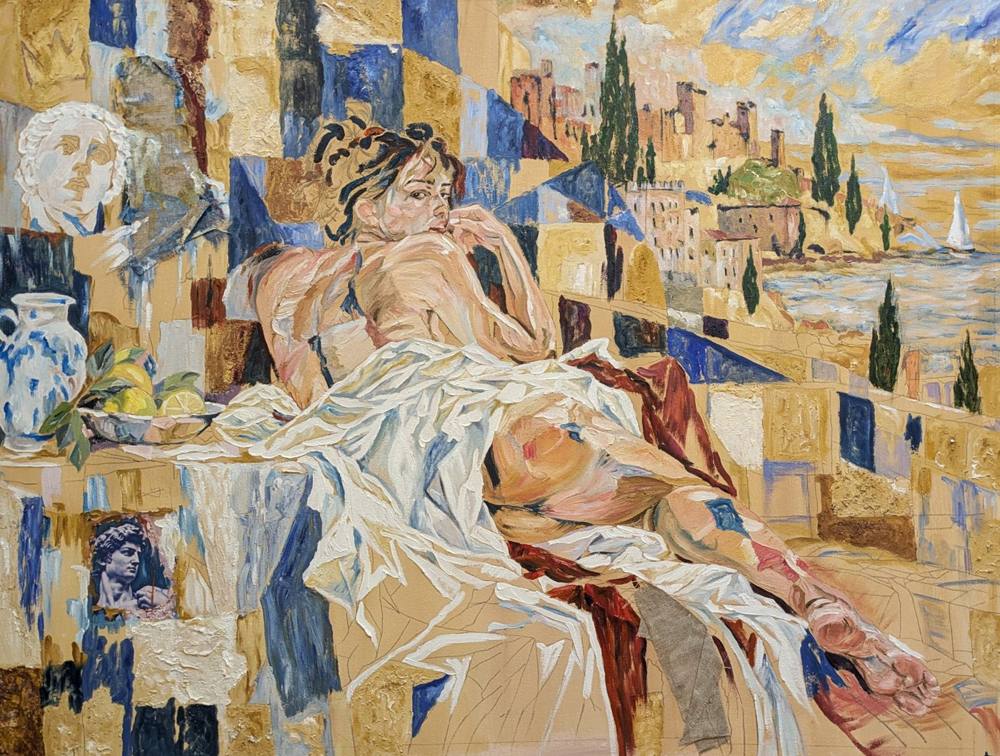
Telas, lino y materiaFabrics, linen and matter
El paño rojo cae hasta el suelo y se integra un trozo de lino real entre las telas pintadas. El drapeado blanco gana empaste y el cuadro queda casi construido.
The red cloth falls to the floor and a piece of real linen is set among the painted fabrics. The white drapery gains impasto and the picture is almost built.
15-10-2026 -
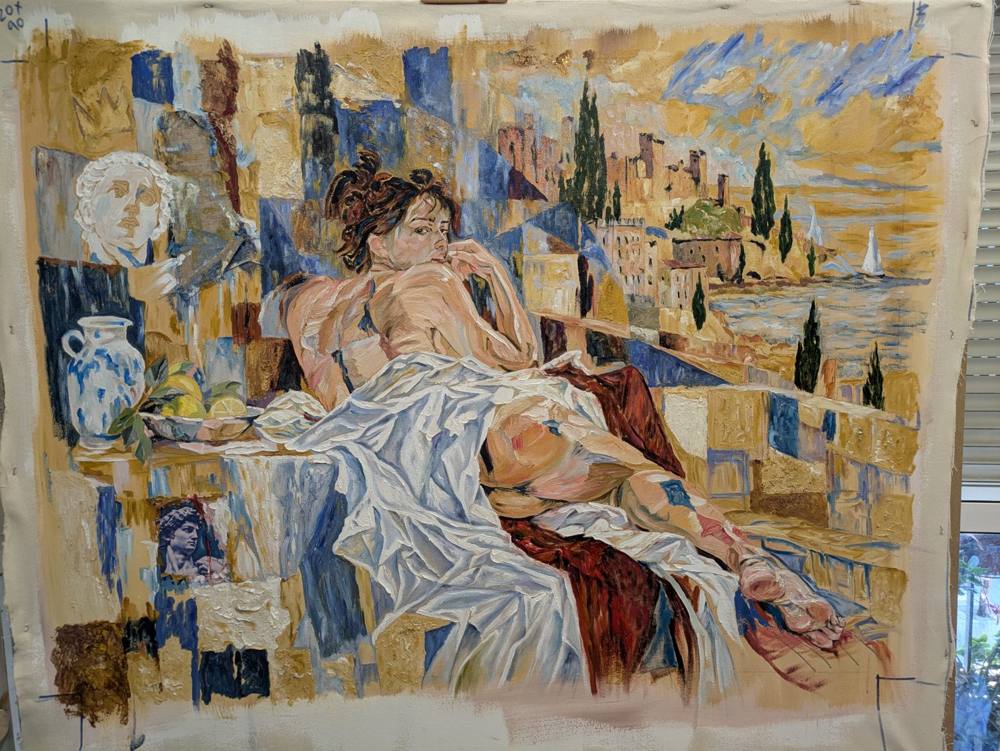
El problema del pieThe problem of the foot
El pie, en el extremo de la diagonal, es lo último por resolver. Con el resto del cuadro casi terminado, se revisan sus luces y sombras antes de repintarlo.
The foot, at the end of the diagonal, is the last thing to resolve. With the rest of the picture almost finished, its lights and shadows are reviewed before it is repainted.
02-11-2026 -
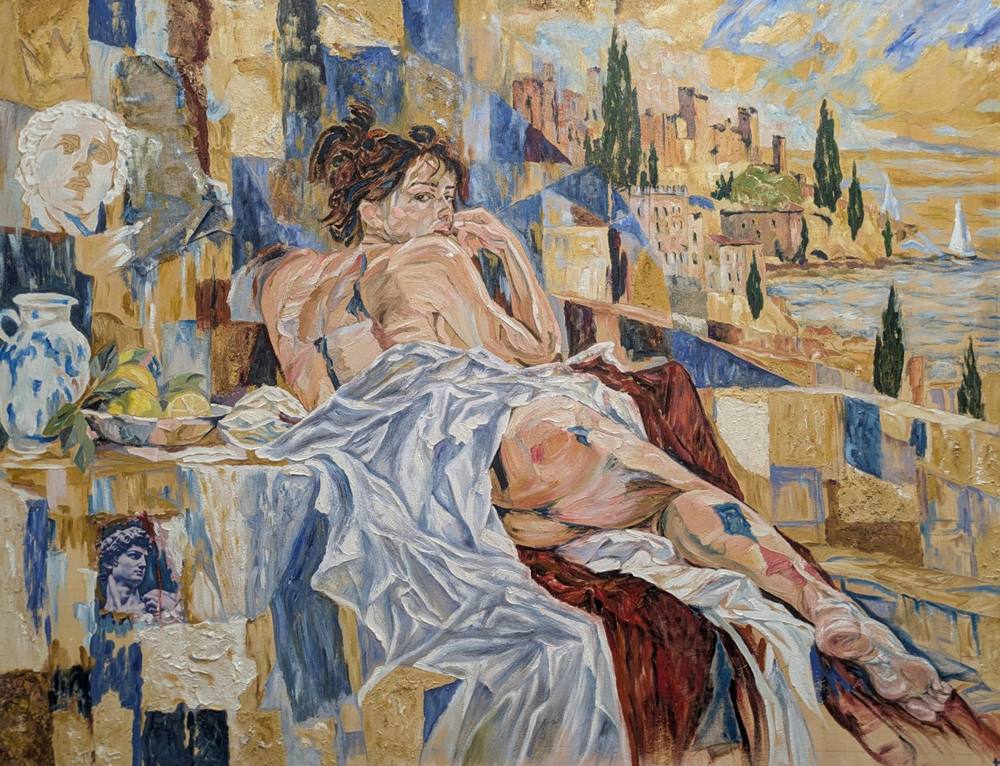
TerminadoFinished
Con el pie repintado, el cuadro se da por acabado. Las zonas de abajo a la derecha conservan a propósito el dibujo y la base ocre: el proceso queda a la vista.
With the foot repainted, the painting is declared finished. The lower-right areas deliberately keep the drawing and the ochre ground: the process stays visible.
03-11-2026
Lucrecio y el De rerum naturaLucretius and De rerum natura
Tito Lucrecio Caro (c. 99–55 a. C.) escribió De rerum natura, «Sobre la naturaleza de las cosas», un largo poema en seis libros que expone en verso la filosofía de Epicuro. Para Lucrecio todo lo que existe, incluidos nosotros, está hecho de átomos que se mueven en el vacío, chocan y se combinan. No hay que temer a los dioses ni a la muerte: entender cómo funciona la naturaleza es el camino hacia la serenidad.
El cuadro parte del comienzo del libro II. Lucrecio dice que es dulce contemplar desde tierra firme la tormenta que sacude a otros en el mar. No porque alegre el sufrimiento ajeno, sino porque es dulce ver de qué males está uno libre. Y añade que nada es más dulce que habitar los «templos serenos» de los sabios, en lo alto, y mirar desde allí cómo los demás andan perdidos buscando el camino de la vida.
Ese lugar elevado es el mirador del título. La mujer reclinada en una terraza sobre el Mediterráneo ocupa el puesto del sabio epicúreo: detrás de ella, el mar y las velas; delante, nosotros. Su mirada por encima del hombro nos devuelve la pregunta: ¿quién mira a quién desde la orilla tranquila?
Titus Lucretius Carus (c. 99–55 BC) wrote De rerum natura, “On the Nature of Things”, a long poem in six books setting out the philosophy of Epicurus in verse. For Lucretius everything that exists, ourselves included, is made of atoms moving through the void, colliding and combining. There is no need to fear the gods or death: understanding how nature works is the path to serenity.
The painting starts from the opening of Book II. Lucretius says it is sweet to watch from dry land the storm that tosses others at sea. Not because another’s suffering brings joy, but because it is sweet to see which evils one is free from. And he adds that nothing is sweeter than to dwell in the “serene temples” of the wise, on high, and look down from there at others wandering, searching for the path of life.
That high place is the lookout of the title. The woman reclining on a terrace above the Mediterranean takes the place of the Epicurean sage: behind her, the sea and the sails; in front, us. Her glance over the shoulder turns the question back on us: who is watching whom from the quiet shore?
«Nada es más dulce que ocupar los templos serenos, bien fortificados por la doctrina de los sabios.» “Nothing is sweeter than to hold the serene temples, well fortified by the teaching of the wise.” De rerum natura, II, 7–8
- Átomos → teselasAtoms → tesserae
El fondo no es un espacio continuo: está hecho de piezas sueltas de color que se juntan y forman muro, cielo o ciudad. Es la imagen pictórica de un mundo hecho de partículas.
The background is not a continuous space: it is made of loose pieces of colour that come together as wall, sky or town. It is the pictorial image of a world made of particles.
- Venus, la naturalezaVenus, nature
El poema empieza con un himno a Venus, fuerza que da vida a todas las cosas. La figura reclinada recoge la larga tradición del desnudo femenino como Venus, pero aquí es una mujer de hoy que nos devuelve la mirada.
The poem opens with a hymn to Venus, the force that brings all things to life. The reclining figure draws on the long tradition of the female nude as Venus, but here she is a woman of today who looks back at us.
- El mar en calmaThe calm sea
El mar de Lucrecio es tormentoso; el del cuadro está en calma. No vemos el naufragio, sino el lugar seguro desde donde podría verse: el cuadro pinta la serenidad, no la tormenta.
Lucretius’s sea is stormy; the painting’s sea is calm. We do not see the shipwreck but the safe place from which it could be seen: the painting depicts serenity, not the storm.
- Placeres sencillosSimple pleasures
Epicuro enseñaba a disfrutar de lo sencillo. Los limones, el jarrón y la luz de la tarde forman un pequeño jardín epicúreo junto a la figura.
Epicurus taught the enjoyment of simple things. The lemons, the jug and the afternoon light form a small Epicurean garden beside the figure.
- La tradición en fragmentosTradition in fragments
El busto clásico y el David de papel son la herencia antigua tal como nos llega hoy: en pedazos, reproducida, pegada sobre la pared.
The classical bust and the paper David are the ancient heritage as it reaches us today: in pieces, reproduced, pasted on the wall.
Cómo está pintadoHow it is painted
ComposiciónComposition
Una gran diagonal recorre el cuadro desde la cabeza, arriba a la izquierda, hasta el pie, abajo a la derecha. Divide el lienzo en dos mitades: a la izquierda, un interior cerrado de teselas, cultura y objetos; a la derecha, la naturaleza abierta, la ciudad y el mar. La figura es el puente entre las dos.
A great diagonal crosses the picture from the head, upper left, to the foot, lower right. It divides the canvas in two: on the left, a closed interior of tesserae, culture and objects; on the right, open nature, the town and the sea. The figure is the bridge between them.
ColorColour
Una armonía controlada de ocres y dorados contra azules ultramar y cobalto, con el blanco de las telas como luz. Un único acento intenso, el rojo del paño, ancla el cuerpo y calienta el centro.
A controlled harmony of ochres and golds against ultramarine and cobalt blues, with the white of the fabrics as light. A single strong accent, the red of the cloth, anchors the body and warms the centre.
MateriaMatter
La superficie es física: empastes gruesos en el drapeado, relieves de creta y piedra pómez en las teselas, papel impreso y un trozo de lino real. Junto a ellas, zonas que dejan ver el dibujo a lápiz y la base ocre. Lo acabado y lo inacabado conviven.
The surface is physical: thick impasto in the drapery, relief of chalk and pumice in the tesserae, printed paper and a piece of real linen. Beside them, areas that leave the pencil drawing and the ochre ground visible. The finished and the unfinished coexist.
Recorrido por los detallesA tour of the details
Pulsa un número para ir al detalle. Pulsa cualquier imagen para verla grande.Tap a number to jump to the detail. Tap any image to see it large.
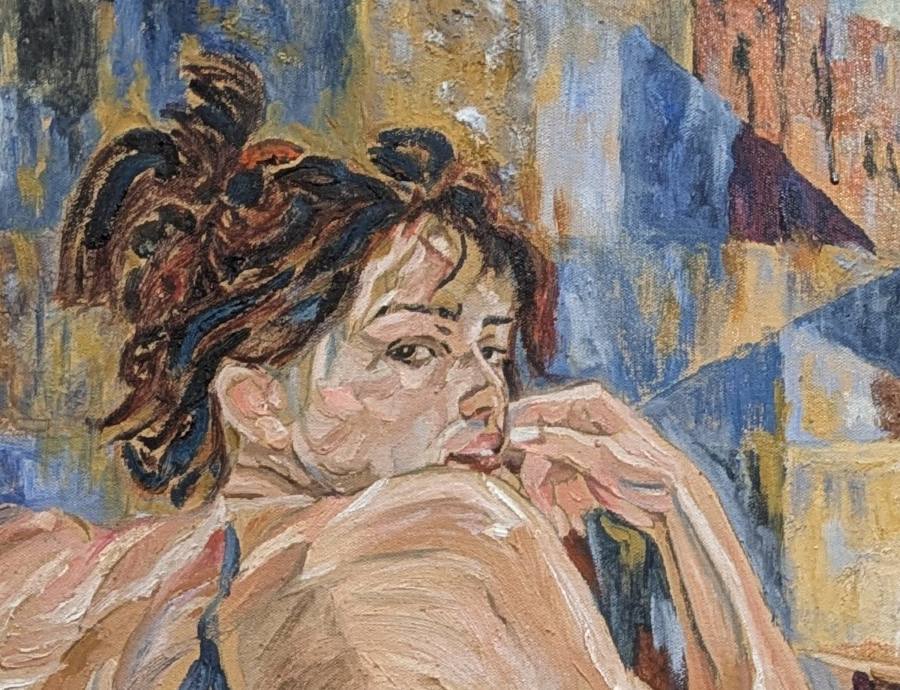
La miradaThe gaze
La cabeza gira por encima del hombro y la mano roza los labios. El rostro está construido con planos de color sin fundir; el pelo, con trazos oscuros y nerviosos que contrastan con la piel.
The head turns over the shoulder and the hand brushes the lips. The face is built from unblended planes of colour; the hair, from dark, nervous strokes that contrast with the skin.
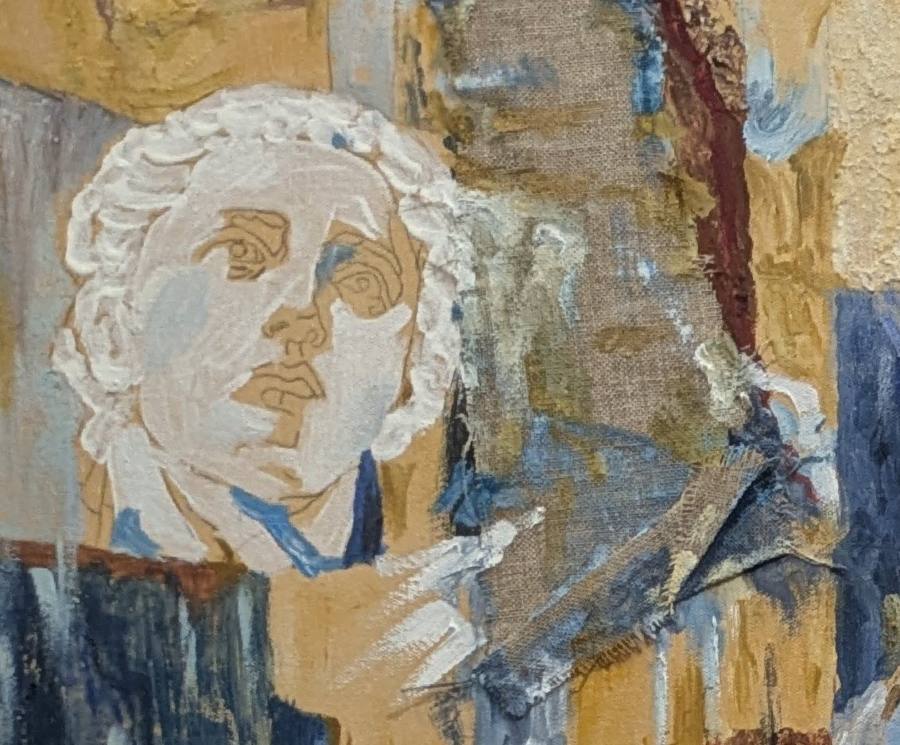
El busto clásicoThe classical bust
Una cabeza antigua en blancos y grises fríos, casi en grisalla, hace de contrapunto a la carne viva de la figura. A su lado asoma la textura del lino.
An antique head in cool whites and greys, almost in grisaille, is a counterpoint to the living flesh of the figure. Beside it, the texture of linen shows through.
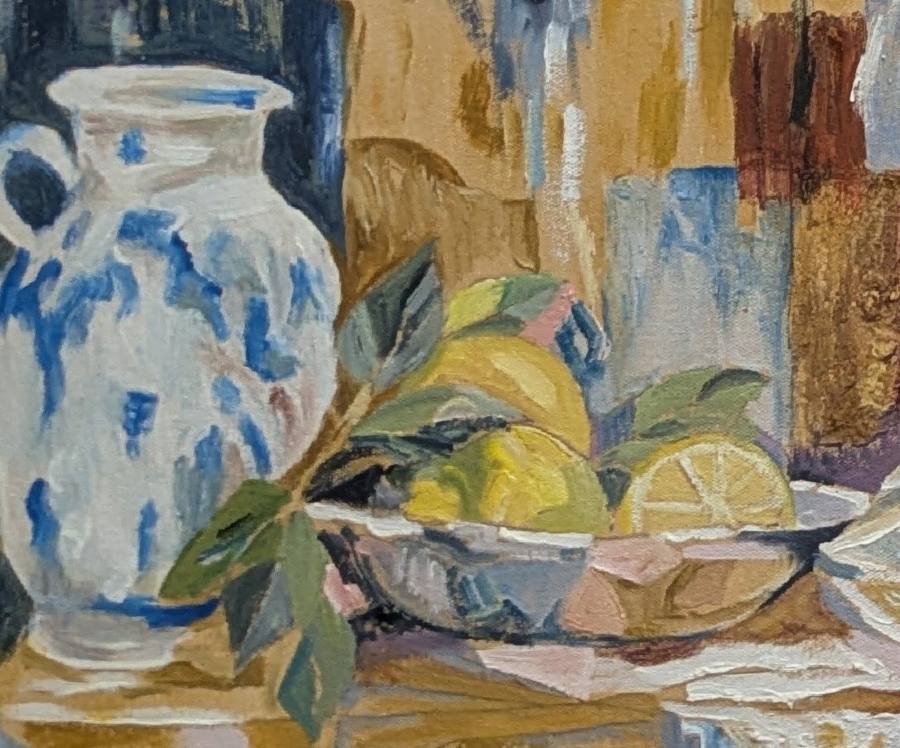
Jarrón y limonesJug and lemons
Un pequeño bodegón mediterráneo: el azul del jarrón repite el de las teselas y el amarillo de los limones prolonga los ocres del fondo.
A small Mediterranean still life: the blue of the jug echoes the tesserae, and the yellow of the lemons extends the ochres of the background.
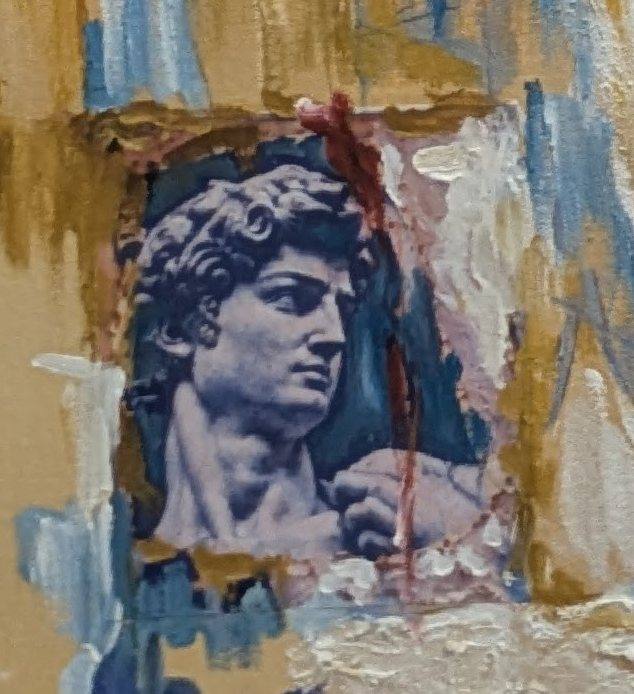
El David de papelThe paper David
Una fotografía impresa del David de Miguel Ángel pegada sobre la pintura. Se queda sin pintar a propósito: es el guiño irónico del cuadro, la obra maestra convertida en recorte.
A printed photograph of Michelangelo’s David glued onto the paint. It is left unpainted on purpose: the painting’s ironic wink, the masterpiece turned into a cut-out.
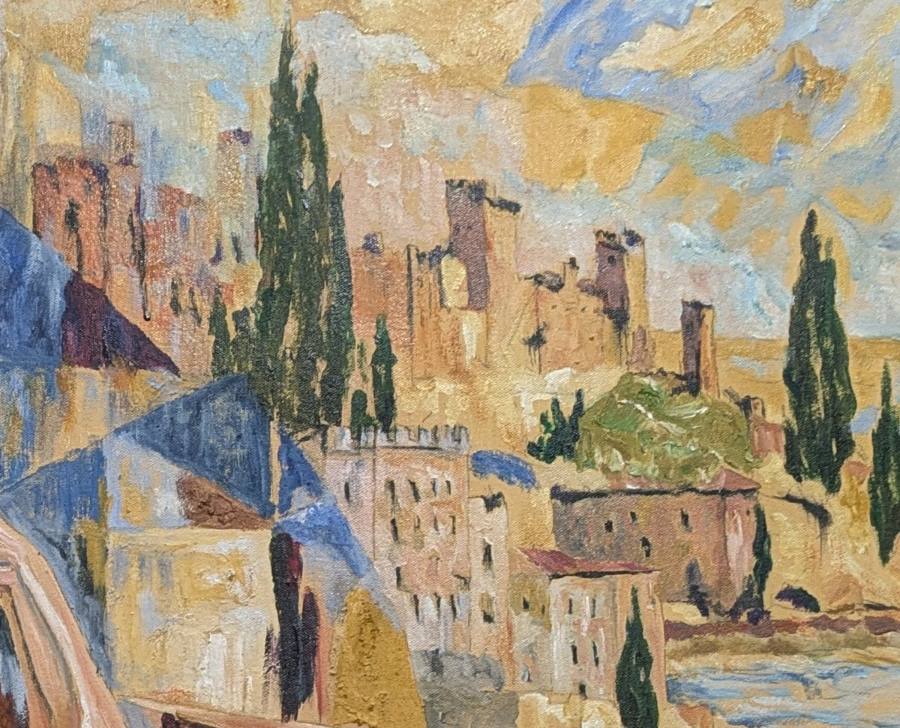
La ciudad imaginadaThe imagined town
Torres, murallas y cipreses de un Mediterráneo inventado, pintados con pinceladas cortas y verticales. Los triángulos azules invaden también la arquitectura.
Towers, walls and cypresses of an invented Mediterranean, painted in short vertical strokes. The blue triangles invade the architecture too.
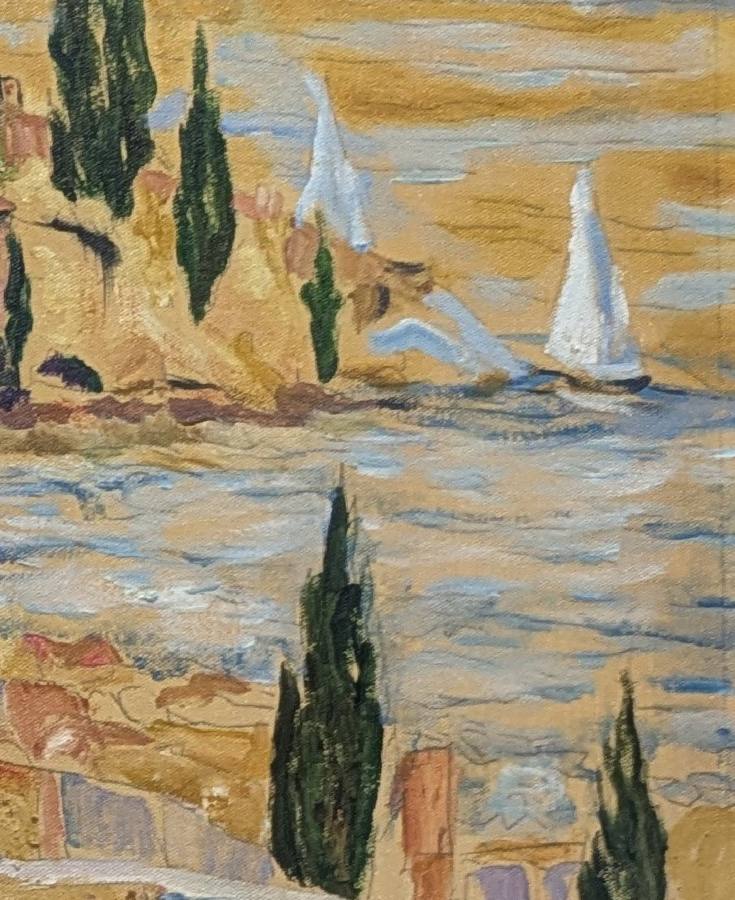
El mar y las velasSea and sails
El mare magnum de Lucrecio, aquí en calma: horizontales de azul y blanco y dos velas que se alejan bajo un cielo dorado.
Lucretius’s mare magnum, calm here: horizontals of blue and white and two sails drifting away under a golden sky.
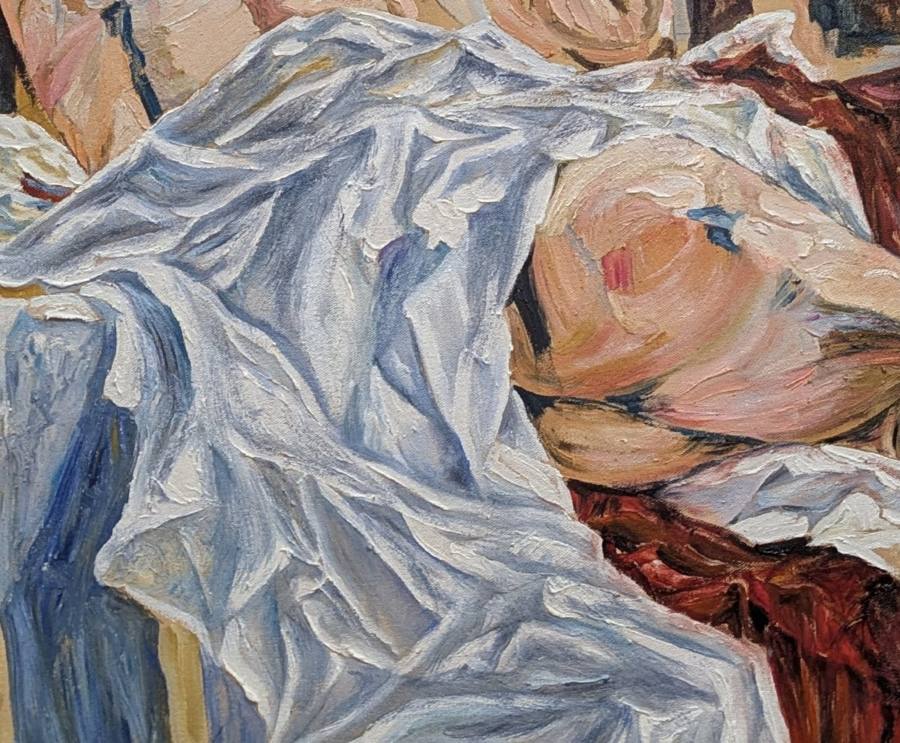
El drapeadoThe drapery
La zona de más empaste. Los pliegues blancos se pintan con espátula y pincel cargado, con sombras azules y violetas, y chocan con el rojo profundo del paño.
The most heavily impastoed area. The white folds are painted with knife and loaded brush, with blue and violet shadows, against the deep red of the cloth.
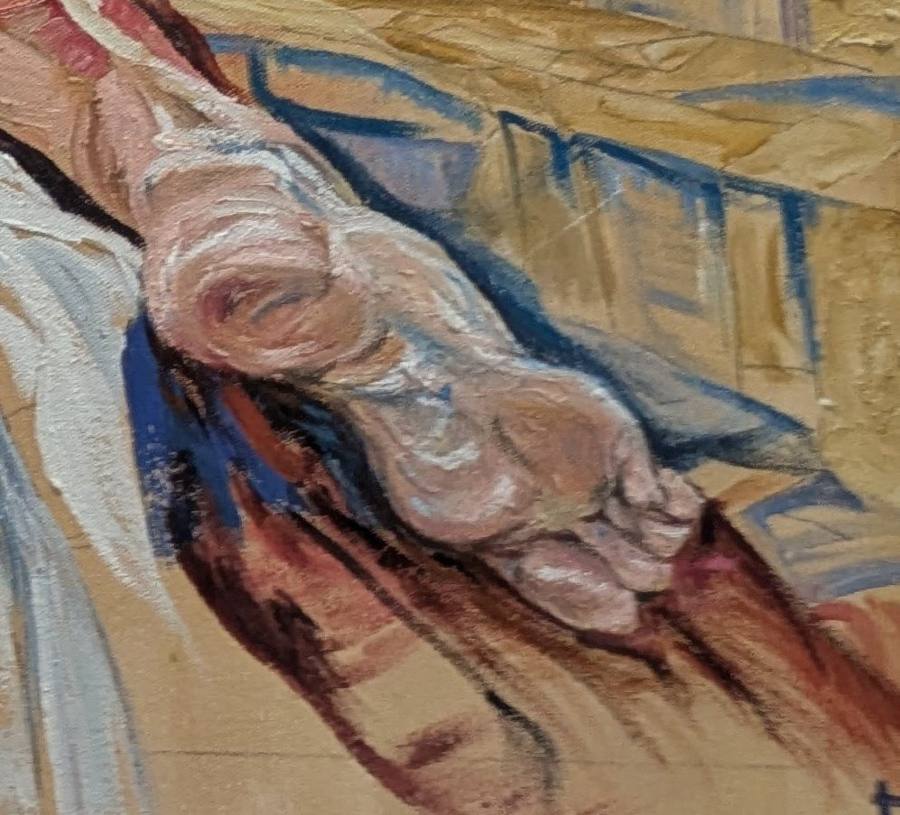
El pieThe foot
El final de la diagonal y lo último que se pintó, tras revisarlo el 2 de noviembre. Luces cálidas y sombras frías; a su alrededor el dibujo queda a la vista.
The end of the diagonal and the last thing painted, after reviewing it on 2 November. Warm lights and cool shadows; around it the drawing remains visible.
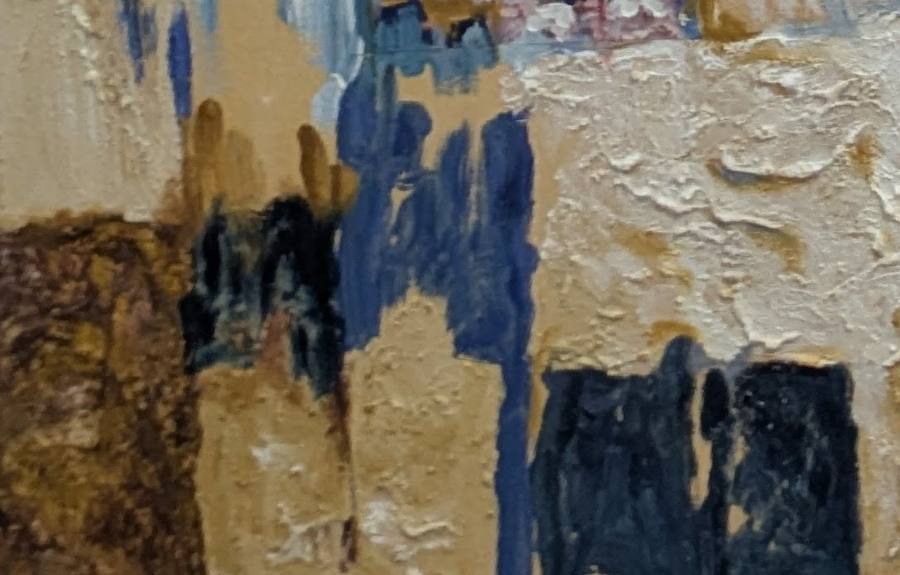
Materia y relieveMatter and relief
Abajo a la izquierda la pintura se vuelve casi abstracta: relieves de creta y piedra pómez, ocres terrosos y bloques de azul oscuro. Es la parte más táctil del cuadro.
At lower left the painting becomes almost abstract: relief of chalk and pumice, earthy ochres and blocks of dark blue. It is the most tactile part of the picture.
Del boceto al cuadro, en vídeoFrom sketch to painting, on video
Un recorrido de unos veinte segundos por las semanas de trabajo: el paisaje imaginado, la figura y el diálogo entre figuración y abstracción.
A twenty-second journey through the weeks of work: the imagined landscape, the human figure and the dialogue between figuration and abstraction.